

Long COVID Patient Navigation Model

Describes how clients become aware of the program, access a referral and enroll in the navigation program.
Click here for more information


Establishes a quantitative starting point before navigation begins. Captures baseline levels of access to care, confidence navigating the healthcare system, goals, quality of life (best days and worst days), participation in daily activities, employment status, and return-to-work readiness. Completed using questionnaires and surveys (i.e. Likert Scale)
This is where the client shares their story, experiences, and current barriers. Individualized goals are collaboratively set with the patient navigator and trust, validation, and emotional safety begin to be established.
Intake
Routine
New Symptoms
Recurrent Symptoms
Exacerbating Symptoms
Employment/Insurance Aid
Socioeconomic Aid
Assesses change over time by re-administering baseline measures to evaluate quantitative outcomes, inform program effectiveness, and support evaluation and funding efforts.
A reflective conversation where the client shares feedback on their navigation experience, including satisfaction with the program, their Patient Navigator, the quality of guidance received, follow-up support, and progress towards their goals (e.g. how many goals were met).
A structured transition informed by clients’ goals and progress, assessed at the one-year mark. Graduation is NOT a full discharge. Clients remain in the system for ongoing monitoring, scheduled 6- and 12-month follow-ups post-graduation and may re-activate navigation services without completing a full intake as symptoms and needs evolve
Describes how clients become aware of the program, access a referral and enroll in the navigation program.
Click here for more information

Establishes a quantitative starting point before navigation begins. Captures baseline levels of access to care, confidence navigating the healthcare system, goals, quality of life (best days and worst days), participation in daily activities, employment status, and return-to-work readiness. Completed using questionnaires and surveys (i.e. Likert Scale).

This is where the client shares their story, experiences, and current barriers. Individualized goals are collaboratively set with the patient navigator and trust, validation, and emotional safety begin to be established.
Intake
Routine
New Symptoms
Recurrent Symptoms
Exacerbating Symptoms
Employment/Insurance Aid
Socioeconomic Aid
Assesses change over time by re-administering baseline measures to evaluate quantitative outcomes, inform program effectiveness, and support evaluation and funding efforts.
A reflective conversation where the client shares feedback on their navigation experience, including satisfaction with the program, their Patient Navigator, the quality of guidance received, follow-up support, and progress towards their goals (e.g. how many goals were met).

A structured transition informed by clients’ goals and progress, assessed at the one-year mark. Graduation is NOT a full discharge. Clients remain in the system for ongoing monitoring, scheduled 6- and 12-month follow-ups post-graduation and may re-activate navigation services without completing a full intake as symptoms and needs evolve.

Patient Navigation Team
h

Role and Scope of Practice

Team Composition and Traits

Navigator Characteristics
Socioeconomic Aid

Assistance connecting to financial, housing, food, transportation, or community support resources.

Frequency

As needed

Length

20-30 min

HEAL-Kit Tools

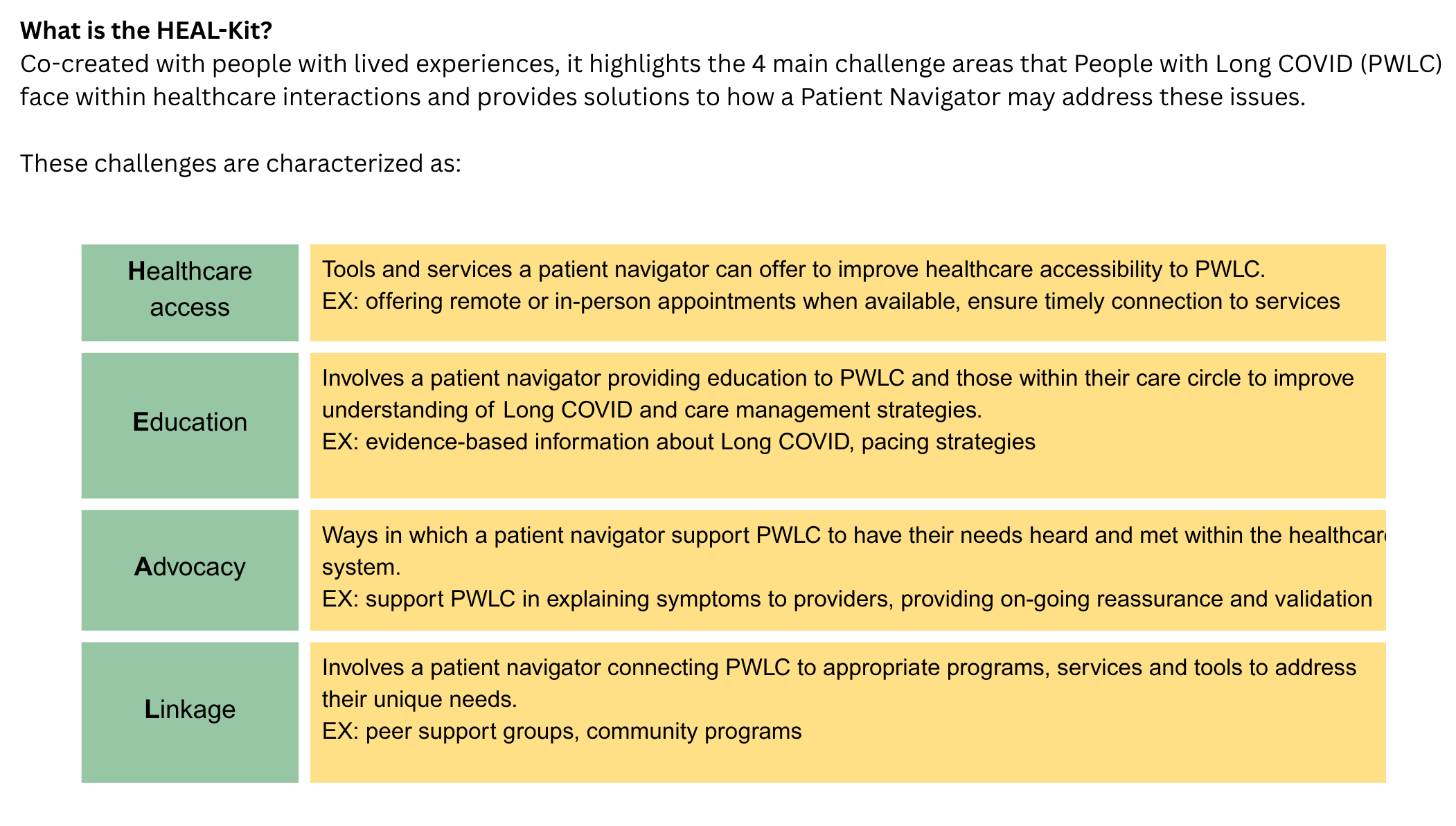
Health Care Access, Education, Linkage (H, E, L)

Employment/Insurance Aid

Support with workplace accommodations, return-to-work planning, disability forms, or insurance issues.

Frequency

As needed

Length

20-30 min

HEAL-Kit Tools

Education, Advocacy, Linkage (E, A, L)

Exacerbating Symptoms

Reach out for guidance on a symptom that is becoming worse, more frequent, or more disruptive.

Frequency

As needed

Length

20-30 min

HEAL-Kit Tools

Health Care Access, Education, Advocacy, Linkage (H, E, A, L)

Recurrent Symptoms

Reach out for guidance on a symptom that had improved or resolved but has returned or is ongoing.

Frequency

As needed

Length

20-30 min

HEAL-Kit Tools

Health Care Access, Education, Advocacy, Linkage (H, E, A, L)

New Symptoms

Contact to discuss and document a new symptom that has developed since the last contact.

Frequency

As needed

Length

20-30 min

HEAL-Kit Tools

Health Care Access, Education, Advocacy, Linkage (H, E, A, L)

Routine Visit

Scheduled follow-up to review progress, ongoing symptoms, care needs, and next steps.

Frequency

Every 3-4 months

Length

20-30 min

HEAL-Kit Tools

Health Care Access, Education, Advocacy, Linkage (H, E, A, L)

Intake

First visit to assess patient needs, symptoms, goals, and appropriate navigation supports.

Frequency

Once

Length

30–60 min

HEAL-Kit Tools

Health Care Access, Education, Advocacy, Linkage (H, E, A, L)